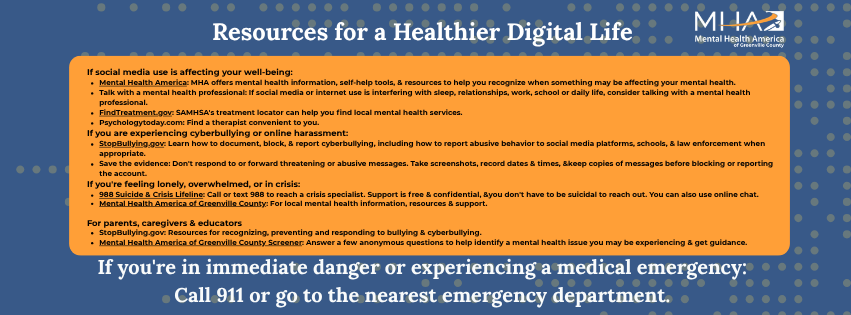
The Hidden Costs of Our Always-Online Lives
We have never had more ways to connect. We can send a message across the country in seconds, watch a friend’s vacation unfold in real time, join a community built around a shared interest, or find thousands of people who understand something we are going through. Our devices can make the world feel incredibly small. And yet, many of us feel increasingly alone. That contradiction is at the heart of our digital lives. We are more connected than ever, but connection and closeness are not always the same thing.
Recent events involving livestreams have brought some of the darker realities of online culture into sharp focus. In early August, celebrity blogger Perez Hilton was hospitalized after appearing to injure himself during a TikTok livestream. The incident prompted viewers to contact authorities, and his family has since shared that he is recovering. Then just days later, news emerged that 26-year-old influencer Mina Chan had died during a TikTok livestream. Reports have described intense online harassment and backlash surrounding Chan in the days before her death, although the full circumstances remain under investigation and it would be inappropriate to reduce her death to a single cause.
These stories are heartbreaking. They also raise difficult questions about what happens when deeply personal moments become public entertainment, when an audience becomes a substitute for a support system, and when the pressure to remain visible never really turns off.
Social media was designed to bring us together, but the way we use it can sometimes leave us feeling more isolated. The endless scroll gives us a steady stream of other people’s lives. We see celebrations, accomplishments, relationships, vacations, opinions, arguments, and carefully edited versions of everyday life. We can participate with a like, comment, or share. Still, those interactions don’t necessarily provide the deeper connection that comes from sitting across from someone and being truly known.
The U.S. Surgeon General has described loneliness and social isolation as important threats to health and well-being, emphasizing that meaningful social connection plays a critical role in individual and community health. Research also increasingly points to a complicated relationship between loneliness and problematic media use. A 2025 meta-analysis of longitudinal studies found an association between loneliness and problematic media use, suggesting that the relationship can work in both directions: loneliness may contribute to problematic use, while problematic use may also reinforce loneliness.
In other words, sometimes we reach for our phones because we are lonely. Then we spend hours online without actually getting the connection we needed in the first place. The cycle can be difficult to break.
The internet can give people a sense of belonging, but it can also give cruelty an audience. Cyberbullying can follow someone home, into their bedroom, and even into the off time when they should be able to escape from what happened at school, work, or somewhere else in the community. A hurtful comment can become a pile-on. A private mistake or photo can become public. A rumor can travel far beyond the people who were originally involved. And, unlike traditional bullying, there may be no clear end of the school or workday. The notifications keep coming. For young people especially, the stakes can be significant. The Surgeon General’s advisory on social media and youth mental health notes that social media can provide benefits while also presenting meaningful risks, and recommends creating boundaries around use, encouraging in-person friendships and taking cyberbullying and online harassment seriously.
If you are experiencing cyberbullying, you do not have to handle it alone. StopBullying.gov recommends documenting what is happening, saving screenshots and other evidence, blocking the person responsible, and reporting abusive behavior to the platform. Depending on the circumstances, it may also be appropriate to involve a school, employer, parent or caregiver, or law enforcement. And if you witness cyberbullying, remember that you don’t have to join the crowd. Don’t share the post. Don’t forward the screenshot. Don’t add another cruel comment. Sometimes standing up for others simply means refusing to make the situation worse and reaching out privately to the person being targeted.
The answer isn’t necessarily to delete every social media account and move to a cabin in the woods. Technology is part of modern life. Social media can help people find community, maintain relationships, learn, advocate for causes, and discover support they might not otherwise have. The goal is not to eliminate the online world. It is to make sure the online world doesn’t become our entire world.
That may mean turning off notifications that don’t need our immediate attention. It may mean leaving the phone in another room during meals. It may mean creating a no-phone hour before bed or taking a social media sabbath one day each week. It may mean charging your devices in another room overnight. It may mean unfollowing accounts that consistently leave us feeling angry, inadequate, or anxious.
It can also mean asking ourselves what we are actually looking for when we reach for the phone. Am I bored? Am I lonely? Am I anxious? Am I avoiding something? Am I looking for reassurance? Am I hoping someone will notice?
Sometimes the most useful question isn’t, “How much time am I spending online?” but “What am I getting from it?” Real-world connection doesn’t have to mean throwing a giant dinner party or suddenly becoming the most social person in town. Call someone instead of sending a text. Invite a neighbor for coffee. Take a walk with a friend. Join a club, volunteer, attend a community event, or find an activity where people regularly gather. Talk to the person sitting next to you. And perhaps most importantly, let people see the real, uncurated version of you.
Authentic connection isn’t constant broadcasting. It requires participation, building relationships. It means listening as well as talking. It means showing up when there isn’t anything interesting to post. It means having conversations that don’t generate likes, shares, or followers.
Sometimes connection looks remarkably ordinary. It looks like sitting on someone’s porch. It looks like laughing with a friend in the grocery store parking lot. It looks like asking, “How are you really doing?” and staying long enough to hear the answer. There is a difference between enjoying social media and feeling as though you cannot step away from it.
We all have a role to play in making online spaces safer. If you come across a post, comment or livestream that appears to encourage self-harm, threatens someone, involves cyberbullying or shows someone who may be in immediate danger, don’t share it, repost it or join the conversation. Instead, use the platform’s reporting tools. On Facebook and Instagram, you can report content for bullying or unwanted contact, suicide or self-injury, violence and other violations. Users can report a livestream by clicking the three-dot menu or Report link positioned directly beside the active video player on Facebook Live or Instagram Live. Users select high-priority categories like “Violence and Incitement.” Reports are generally anonymous. TikTok also provides reporting tools for content that violates its Community Guidelines, including content involving suicide, self-harm, bullying and harassment. Viewers flag a live stream by tapping the Share icon, choosing Report, and selecting the exact subtopic of real-world violence.
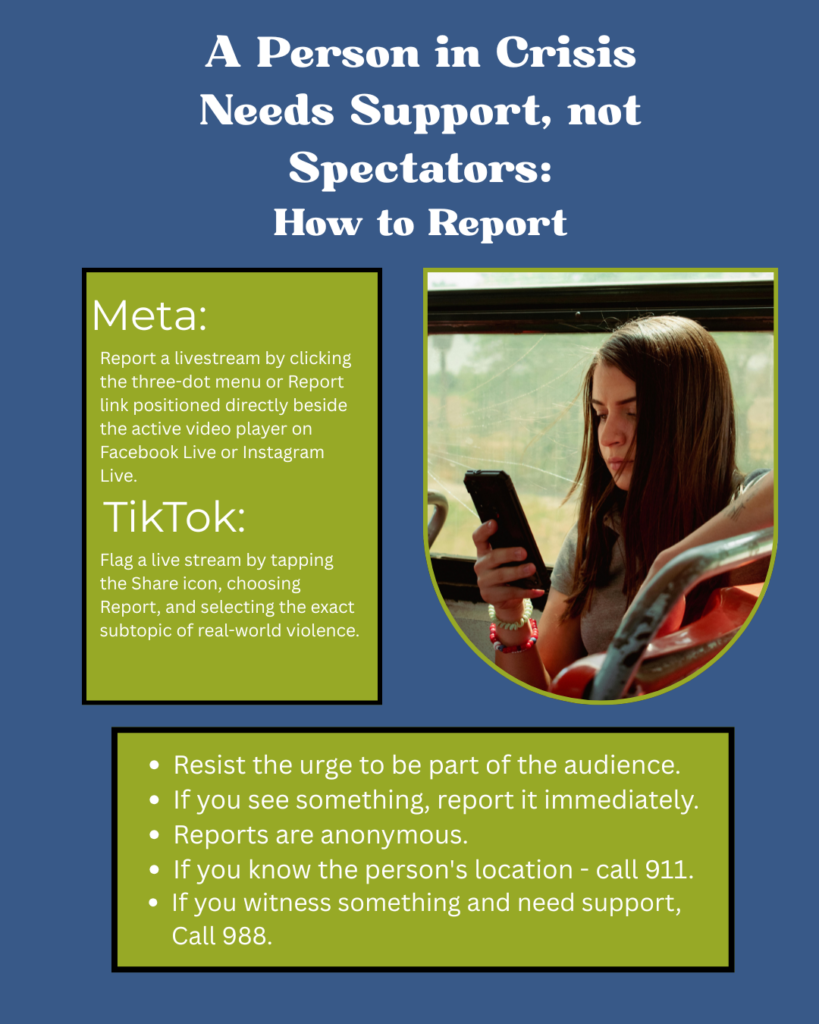
If someone appears to be in immediate danger, however, don’t rely on a social media report to get them help. Contact emergency services or, in the United States, call or text 988 to reach a crisis specialist. When possible, provide the person’s username, the platform they’re using, and any relevant details to help responders understand the situation. Most importantly, resist the temptation to become part of the audience. A person in crisis needs help, not spectators.
If online activity is interfering with sleep, work, school, relationships, or daily responsibilities, or if you repeatedly try to cut back and find that you cannot, it may be worth talking with a mental health professional. The same is true if social media use is making you feel increasingly anxious, depressed, isolated, overwhelmed, or just plain bad. You don’t have to wait until things reach a crisis point to ask for help.
And if cyberbullying or online harassment is affecting your mental health, tell someone. A trusted friend, family member, teacher, supervisor, mental health professional, or other supportive person can help you figure out what to do next. If you are struggling emotionally, feeling overwhelmed or experiencing a mental health crisis, call or text 988. You will be connected with a crisis specialist who can listen, help you work through what is happening, and connect you with additional resources when needed.
The internet can connect us to millions of people. But sometimes the connection we need is much smaller: one person, sitting beside us, willing to listen. We don’t have to choose between technology and connection. We just have to remember that a screen is a tool for connecting—not a replacement for connection itself.
Put down the phone. Look up. Check in. Reach out.
Sometimes the most important connection is the one happening right in front of us.